


Dental Implants in Princes Risborough
If you have a missing tooth, several gaps or a denture that moves when you eat, dental implants can replace missing teeth with ones that are fixed firmly in place. At Bank House Dental Centre, every implant is placed and restored by Dr Sanjay Narda, who has been placing dental implants for over 20 years. We welcome patients from Princes Risborough, Thame, Chinnor, Haddenham, Aylesbury and the surrounding villages.
Your first step is a free 15-minute discussion with Dr Narda. It is open to everyone, whether or not you are registered with us. To book, call 01844 343381 or send us a message.
What is a dental implant?
A dental implant is a small titanium post that is placed in the jawbone to replace the root of a missing tooth. Over the following months the bone bonds to the implant, which can then support a crown, a bridge or a denture.
An implant stands on its own. The teeth either side do not have to be cut down to support it, as they are for a conventional bridge. That fits our approach of keeping treatment to a minimum and preserving your natural teeth wherever possible. An implant also helps to preserve the bone, which otherwise slowly shrinks where a tooth has been lost.
Hear from our implant patients
What dental implants can do
These photographs show our own patients, treated here at Bank House, and are shared with their permission.
Replacing a single tooth
A single implant carries a crown that is made to match the teeth beside it. It is designed to look and work like a natural tooth, and the neighbouring teeth are left untouched.

Case 1

Replacing several teeth
When several teeth are missing, each one can have its own implant and crown. Alternatively, two or more implants can support a bridge, so that fewer implants are needed than teeth replaced.

Case 2

Case 3

Case 4

Holding a denture firmly in place
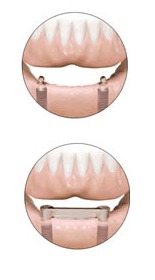
If you wear a full denture that feels loose, two or more implants can be fitted with attachments that the denture clips onto. An implant-retained denture stays secure when you eat and speak, and you can still take it out to clean it.
Implants, bridges or dentures?
There is more than one way to replace missing teeth. A conventional bridge is fixed in place and is quicker to make, but the teeth either side of the gap usually have to be prepared for crowns. A denture is the simplest and least costly option, but it is removable and some people find it less secure. An implant is fixed, does not rely on the other teeth, and helps to preserve the bone. It involves a small operation, takes longer and costs more.
Implants are not the right answer for everyone. We will explain all of your options, including the simplest, so that you can decide what suits you.
Are dental implants right for me?
Most adults in good general health can have dental implants. You need healthy gums and enough bone to hold the implant, and we check both at your assessment. If your gums need treatment, that comes first.
Some things make implants less likely to succeed. The main ones are smoking, diabetes that is not well controlled, and gum disease that has not been treated. Please tell us about your health and any medicines you take. If implants are not suitable for you, we will say so and suggest an alternative.
How implant treatment works
1. Free first discussion. A 15-minute conversation with Dr Narda about what you would like and whether implants might suit you. It is not an examination and does not include X-rays.
2. Assessment. If you would like to go further, we examine your teeth, gums and bite and take the X-rays needed to plan your treatment.
3. Your written plan. We explain your options and give you a written estimate. There is no obligation to go ahead.
4. Placing the implant. The implant is placed under local anaesthetic, in the same way as other dental treatment. Most patients find it more comfortable than they expected, with some soreness for a few days afterwards. If you are nervous, a mild sedative can be arranged.
5. Healing. The implant is left to bond with the bone, which usually takes about three months. A temporary tooth can fill the gap during this time.
6. Your new tooth. For implant crowns and bridges we take a digital scan of your mouth rather than a conventional impression. Your crown, bridge or denture is then made and fitted.
7. Looking after your implant. We check your implants at your regular check-ups and hygienist visits.
Your implant dentist
All implant treatment at Bank House is provided by Dr Sanjay Narda (GDC number 74529), clinical director of the practice since 2005. He qualified from the University of Leeds in 1998 with BChD (Hons), holds a Postgraduate Diploma in Restorative Dental Practice from the UCL Eastman Dental Institute (2007), and is a Fellow of the International Congress of Oral Implantologists.
Dr Narda has been placing implants for over 20 years and has placed hundreds of them. He carries out every stage himself, so you see the same dentist from your first discussion to your final check. He also has long experience of looking after nervous patients. Our patients rate us five stars on Google. You can read more on our team page.
How long implants last, and looking after them
In our own audit, more than 95% of the implants Dr Narda has placed were successful five years later. Implants are designed as a long-term replacement, but like natural teeth they depend on healthy gums.
You clean an implant much as you clean your own teeth: brushing twice a day and cleaning between the teeth, with regular hygienist visits and check-ups. The crown, bridge or denture on top can wear, as any dental work does, and may need replacing in time.
Cost of dental implants
Your first discussion is free. A single implant with its crown starts from £2,600. The cost depends on how many implants you need and what they support, so before anything is started you will receive a written estimate, which we keep to.
What our implant patients say
Over the course of three years I have had extensive dental work done at this surgery, including six implants and two complex crown/bridge units. I am now able to chew efficiently and my teeth look so much better. The treatment was always carefully explained to me and the pricing made clear beforehand. It was carried out as comfortably as possible.
I have experienced several dentists in the past, both NHS and private, and I can honestly say Dr Sanjay Narda is the best. He is calm and considered, performing work to the highest standard. I was so impressed I am now registered here for regular general dental care and would thoroughly recommend it.
… My teeth and jaw were badly damaged after an accident and I needed several teeth removing, I didn’t think my mouth would ever feel ok again. It has taken a year for my jaw to heal and for Sanjay and the team to get my implants in, they have been so professional, careful, caring and mindful of my needs all along the way and now my implants are in they are so much better than I dared to hope. This is an excellent dental practice that can manage complex dental care as well as general maintenance.
Just a quick note to say I am very happy with the three implants Sanjay fitted and would not hesitate to recommend your practice to anyone wishing to have implants. The whole process was painless including the extractions beforehand. I felt very much at ease with Sanjay, and had no worries at any stage of the treatment. Thank you for making it such a pleasant experience.
Read more reviews from our implant patients
Frequently asked questions
Does having a dental implant hurt?
The implant is placed under local anaesthetic, so the area is numb. Afterwards you can expect some soreness and perhaps a little swelling for a few days, which ordinary painkillers usually deal with.
How long does implant treatment take?
Usually a few months from start to finish. Placing the implant takes one visit. It is then left to heal for about three months before your new tooth is made and fitted.
How long do dental implants last?
With healthy gums and good cleaning, implants are designed to last for many years. The crown or bridge on top may need replacing sooner than the implant itself.
How successful are dental implants?
In our own audit, more than 95% of the implants placed here were successful five years later. Smoking and gum disease are the main things that reduce the chance of success.
Am I too old for dental implants?
There is no upper age limit. Your general health and the health of your gums matter more than your age. Implants are not placed in children or teenagers, whose jaws are still growing.
Can I have implants if I smoke, or have diabetes or gum disease?
Often, yes, but the risks are higher. Gum disease needs to be treated first, diabetes should be well controlled, and we strongly advise stopping smoking. We will give you an honest opinion at your assessment.
What if I don't have enough bone?
We check this at your assessment. If there is not enough bone for an implant, we will tell you and talk through the alternatives, such as a bridge or a denture.
Will I have a gap while the implant heals?
You do not need to. A temporary tooth can fill the gap until your new tooth is fitted.
I am nervous about treatment. Can you help?
Yes. We have a great deal of experience with anxious patients and will take things at your pace. A mild sedative can be arranged if you would like one.
Do I need to be a patient at Bank House, and where are you?
No. The free first discussion is open to everyone, and we are taking new patients. We are at 80 High Street, Princes Risborough, HP27 0AX, with free one-hour parking on the High Street and several car parks nearby. Many of our patients travel to us from Thame, Chinnor and Haddenham.
To book your free dental implant discussion at Bank House Dental Centre in Princes Risborough, call us on 01844 343381 or send us a message.

